Mentoring undergraduate researchers
Since George Fox University has no graduate program in biology, undergraduate students played a key role in lab productivity. Peer-reviewed publications resulting from work done by research teams in the lab often include undergraduate coauthors who made important contributions to both data collection and analysis.
My mission in involving undergraduates in my research program was to provide a quality experience that prepared them to be competitive for and successful in top-level graduate programs once they finished their degree. Students who took positions in my lab took ownership of entire projects rather than specific experiments, so they gained valuable experience in all facets of basic research. This included presentation of their work at the Society for Integrative and Comparative Biology (SICB) national meeting each January.
While I never had the opportunity to have official graduate students, I had the joy and pleasure of working with 80–90 budding undergraduate scientists in my lab over the years who performed well beyond what anyone expected. Even though I set the bar high, without exception my students leapt well over it.
Students who took positions in my lab took ownership of entire projects rather than specific experiments, so they gained valuable experience in all facets of basic research.
Where are they now?
Paige (Copenhaver) Parry, Ph.D.
GFU Class of 2012 — Ph.D., University of Wyoming; J. Exp. Biol. 218:1410–1418 (2015)
Rosalee Elting
Ph.D. candidate, University of Montana; lead author, Funct. Ecol. 40:1475–1490 (2026)
Keely (Corder) Luongo, Ph.D.
GFU Class of 2011 — Ph.D., University of Montana; R. Soc. Open Sci. 2:150598 (2015)
Noemi (Camacho) Soveral
GFU Class of 2016 — Supervisor, OHSU Primate Research Center; J. Therm. Biol. 112:103391 (2023)
In their words
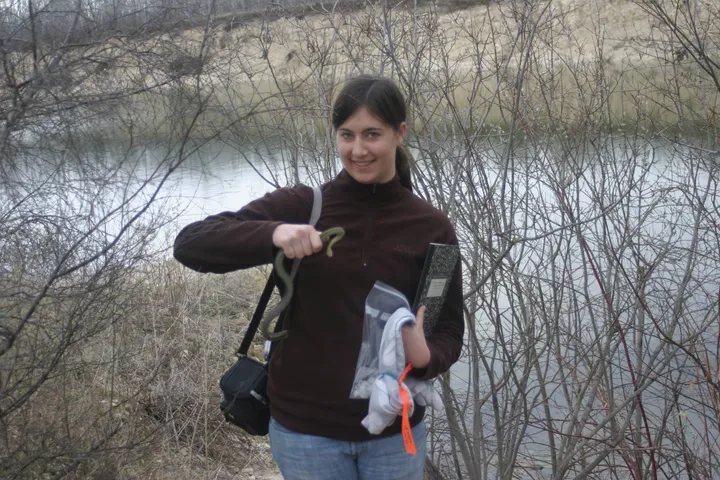
As an undergraduate biology major at George Fox, I had the opportunity to conduct research under Don for two years, including a summer field season. The experience I gained in the Powers Lab was absolutely invaluable in preparing me for graduate school. Don was incredibly generous in allowing me to make my projects my own, and allowed me the freedom to learn through my own experimentation. That being said, I found him to be readily available to answer questions and guide me in the right direction whenever I had a question. The caliber of research that Don and his students produce is impressive, particularly considering the fact that the projects are carried out by undergraduate students. I believe this is a testament to Don's strong teaching skills, as well as his commitment to excellence and high yet realistic expectations for his students. The volume of knowledge I gained while conducting my projects was surprising, yet quite manageable with Don's support, and gave me a thorough introduction to the rigors of graduate school. I not only obtained a strong understanding of the research process, but came away with two completed projects, a much stronger CV, and presentations at local and national conferences. Upon entering my graduate program, I felt exceptionally well prepared and mainly attribute that to my experience in the Powers Lab.
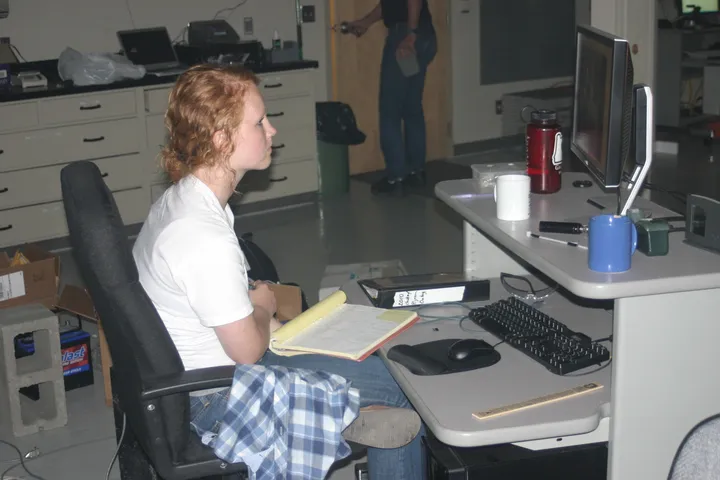
When I first joined the Powers lab as a junior, I was looking for research experience that would help determine if this was the kind of career I wanted to pursue. Four years later, I am certain my time in the lab has been one of the most formative experiences of my career as a scientist. Dr. Powers's approach to his undergraduate research students is truly one-of-a-kind. I know of no other undergraduate researchers that have the independence, guidance, and hands-on experience that is typical in the Powers lab. I can say first hand that those qualities were hugely influential to my getting into graduate school and to my success as a graduate student. As I continue my education in biology, Dr. Powers continues to be an incredibly valuable mentor and friend!
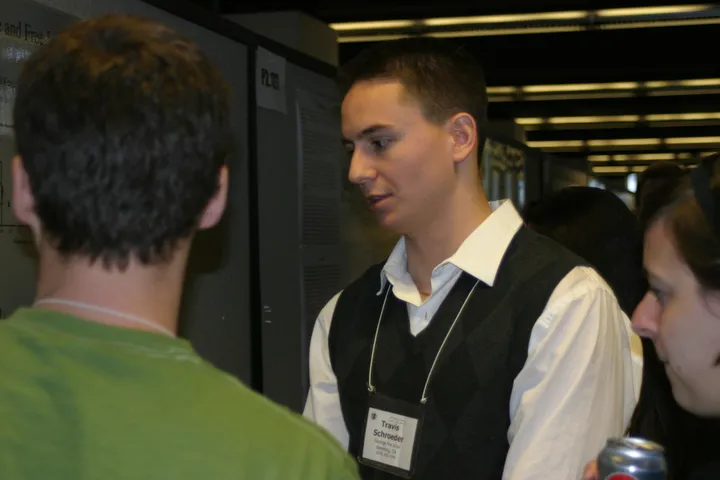
At the core of medicine is a strong foundation in basic sciences. Nothing could have prepared me better for medical school and a career as a physician than the education I received at George Fox. Central to my education was the time I spent in the Powers Lab. Dr. Powers gave me the freedom and responsibility to design and carry out my own project and helped me hone my presentation skills at numerous events and conferences. Many of my current colleagues hold graduate degrees from various prestigious schools. They are frustrated when they find out that I've had at least as much experience designing experiments and collecting, analyzing and presenting data as they have … but I got to do it while playing with hummingbirds.
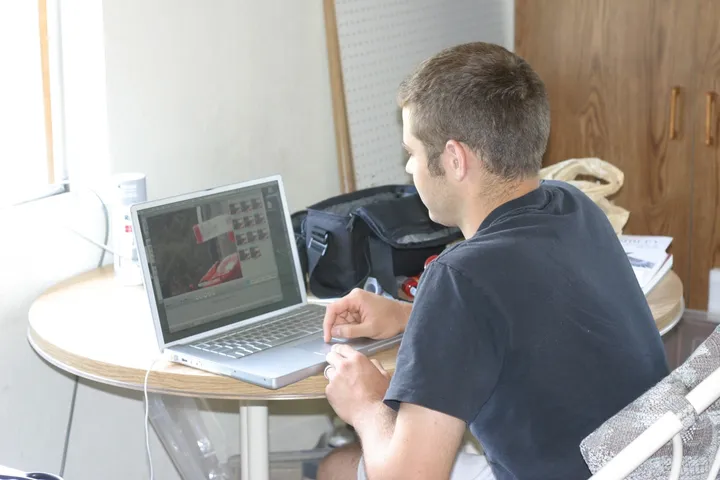
I can't say enough about what a valuable experience it was to work in the Powers Lab during my time at George Fox. Moving beyond the classroom and experiencing new scientific discovery enriched and enhanced my whole academic career. I went on to graduate school in the healthcare field, and the skills which I honed in my time working with Dr. Powers, including how to really dig into the scientific literature, ask good questions, have original thoughts, and get up in front of a group and convey information, have all helped me immeasurably throughout my training and in my career. In addition, I was able to accomplish one of my life goals by coauthoring a publication with Dr. Powers in Comparative Biochemistry and Physiology.
Student researchers, 2006–2022
- 2022
- Whitney Dobbyn (MAT Program, GFU), Emily Blackwell, Kendra (Geer) Wisenbaker (MAT Program, GFU), Emma Ortiz
- 2021
- Audrey Smith (Research Technician, OHSU), Tiffany Regier (Medical Student, Chicago College of Osteopathic Medicine), Whitney Dobbyn (MAT Program, GFU), Emily Blackwell
- 2020
- Audrey Smith (Research Technician, OHSU), Tiffany Regier (Medical Student, Chicago College of Osteopathic Medicine)
- 2019
- Elliot Shannon (Ph.D. Student), Nathaniel Shiiki
- 2018
- Natalie Amodei, Sarah Thompson (Medical Student, A. T. Still University Osteopathic Medicine Program)
- 2017
- Isabelle Hoyven Cisneros (DPT), Emma Bloomquist, Kaheela Reid
- 2016
- Julie Litchfield (DNP Student, University of Southern Maine), Elizah Stephens (Ph.D. Student, University of California, Riverside), Nathan Weston (Medical Student, Case Western University)
- 2015
- Noemi (Camacho) Soveral (Supervisor, Clinical Medical Unit, Primate Research Center, OHSU), Rosalee Elting (Ph.D. Student, University of Montana)
- 2014
- Noemi (Camacho) Soveral (Supervisor, Clinical Medical Unit, Primate Research Center, OHSU), Joseph Canepa (Teacher), Sara Nutter (Graduate School, Art), Rebecca Schroeder (Ranger, US National Park Service)
- 2013
- Joseph Canepa (Teacher), Kathleen Langland (Marine Science Research), Rebecca Schroeder (Ranger, US National Park Service)
- 2012
- John Luke Andrew (Dentist), Elliott Davis (Medical Student), Kathleen Langland (Marine Science Research)
- 2011
- Ryan Lane (Postdoctoral Fellow), Kyle Maki, Paige (Copenhaver) Parry (Ph.D., Wyoming Natural Diversity Database, University of Wyoming)
- 2010
- Keely Corder (Ph.D., University of Montana), Ryan Lane (Postdoctoral Fellow), Jessi-Ann Michaelson (Nurse Practitioner)
- 2009
- Jessi-Ann Michaelson (Nurse Practitioner), Seth Monson (Dentist)
- 2008
- Jessi-Ann Michaelson (Nurse Practitioner), Seth Monson (Dentist), Travis Schroeder (Physician)
- 2007
- Kevin Watanabe-Smith (Ph.D., OHSU)
- 2006
- Philip Getsinger (Dentist)